
Data Reconciliation
Ensure Data Integrity Across Every Source and Target.
Data Reconciliation identifies inconsistencies and critical changes between datasets by comparing row-by-row table data, across sources — without writing Python scripts or complex coding.
Ensure Data Integrity with Data Reconciliation Checks
Critical for ensuring high-quality data, reconciling data involves comparing row-level values from different tables to check the accuracy, consistency, and completeness of data.
Data breaks, all the time. Sometimes for no reason. And when data is in motion — moving from different source systems to various target destinations — data is especially prone to errors or mutations.
By using Lightup for Data Reconciliation, enterprise data teams can easily find data discrepancies, so they can be resolved quickly — before downstream escalation.
Key Use Cases for Reconciling Data
Cloud Migration
Data Pipeline Validation
Lightup Data Reconciliation Checks
Also referred to as Data Compare or “Data Diffing,” Lightup’s Data Reconciliation Checks enable you to compare data row by row from different sources to see if any values have changed during migrations or data pipeline validation processes:
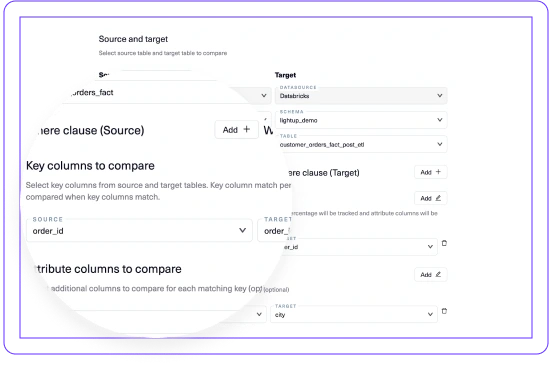
- Comparing Key and Target Columns — select key and target columns to uniquely identify records and focus on relevant data points.
- Optimized Data Extraction — Lightup extracts the appropriate data, optimizing the reconciliation process by minimizing data volume.
- Local Data Comparisons — advanced algorithms analyze data locally, identifying discrepancies without requiring data transfers between sources.
- Discarding Raw Data — Lightup discards raw data post-comparison, mitigating potential security and compliance risks.
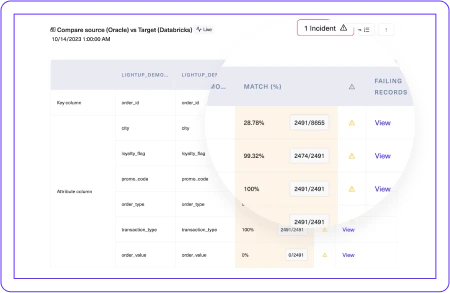
- Percentage Matching — see the percentage of matching data for quick identification and resolution of discrepancies.
Why Lightup for Data Reconciliation?
Efficiency
Accuracy
Security
Ease-of-Use
Improved Decision-Making
Customization
Resources
Deliver Trusted Data for Business-Critical Applications.