


As organizations continue to modernize their data management and race to implement more AI-driven data products, the need for reliable, accurate, and auditable data is now more critical than ever. Large enterprises managing massive amounts of data, running complex pipelines, and working with AI and ML applications rely heavily on the integrity and accuracy of data.
So, how can enterprises maintain data reliability and traceability throughout the data life cycle?
That’s where Data Lineage comes in.
What Is Data Lineage?
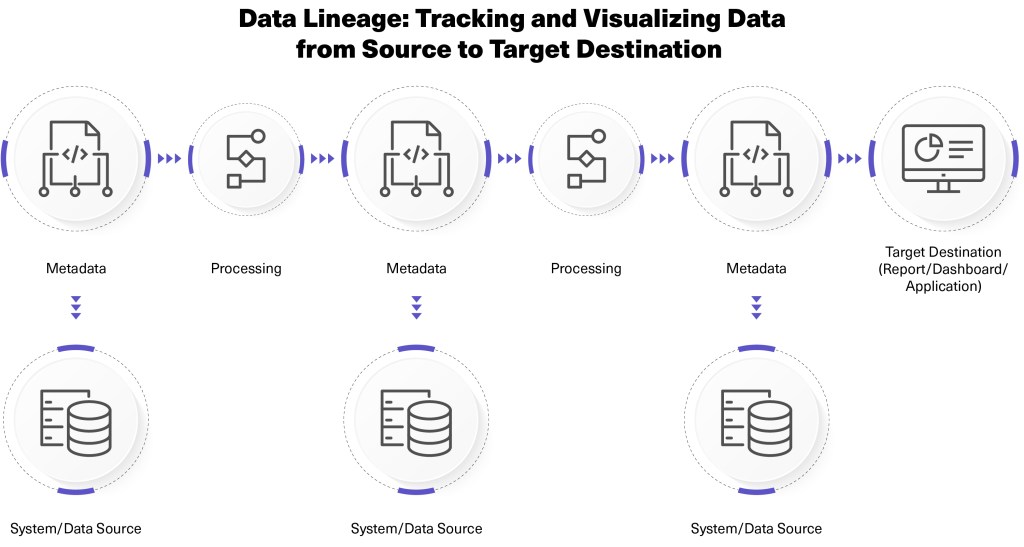
Data Lineage is the process of tracking and visualizing the flow of data from its origin or source, through all processing stages, until it reaches its final form or target destination.
By helping organizations understand the flow of data across its life cycle, Data Lineage provides answers to questions such as:
- Where did the data come from?
- What are the downstream dependencies?
- What’s the final target destination of the data?
Think of Data Lineage as a map, showing where data originated (the source), how it’s been changed or transformed (data processing), and where it’s going for consumption (target destination). This allows organizations to keep track of these processes, gaining visibility and traceability into each stage of the data pipeline.
Why Is Data Lineage Critical for Modern Data Management?
Data Lineage plays a crucial role for organizations implementing modern data management systems, especially when it comes to Data Governance and Data Quality.
Here’s why:
Traceability: Since Data Lineage provides granular visibility into where data came from and where it’s going, identifying issues like inconsistencies or unexpected changes becomes much easier.
Identification of Data Quality Gaps: By tracking data across each stage of its life cycle, Data Lineage can identify systemic gaps in Data Quality coverage — for example, which nodes are missing automated validation checks or where data isn’t monitored for inconsistencies as it flows through pipelines.
Root Cause Analysis: Data Lineage helps teams diagnose the root cause of incidents, even when issues arise that don’t cause pipeline failure outright. If downstream reports show incorrect figures, lineage maps can reveal whether the problem originated from missing fields in the source system or if errors were introduced in later processing phases.
Impact Analysis: Data Lineage enables teams to assess the downstream impact — or blast radius — of poor-quality data or unexpected schema changes. For example, if rows and columns get dropped from the parent table, Data Lineage indicates the downstream dependencies in child tables.
How Data Lineage Works in Practice
What does this look like in practice? Imagine you’re working with raw product data in a Postgres database. You move this data into Snowflake, changing some category names to fit your SQL database schema. At each step, you document what happens to the data: what’s dropped, what’s changed, and the state of the data at each stage.
This metadata trail captures:
- Where the data came from and where it’s going.
- What columns or rows were altered or removed.
- When and where those changes took place.
Even when an ETL pipeline itself doesn’t fail, Data Lineage can help identify any discrepancies in the data — such as a sudden drop in the number of rows in the product table, despite the raw product data remaining the same.
This level of granular visibility is critical in complex data environments, since it helps teams quickly identify the relationship between data assets and the exact blast radius of incidents on downstream processes.
Lightup for Data Lineage
At Lightup, we understand that to get the most out of Data Lineage, you need to combine it with contextual Data Quality insights. That’s why we’re excited to announce the beta release of Lightup for Data Lineage, designed to make it easier than ever to track and visualize the flow of data with integrated incident status warnings at every phase.
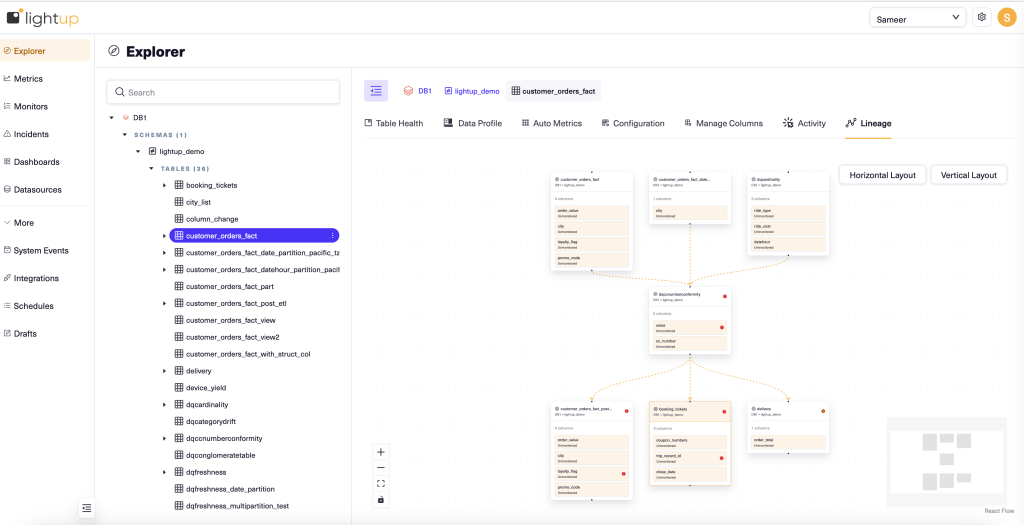
Lightup Data Quality and Lineage go hand in hand for faster, more efficient root cause analysis. You’ll also see any gaps in Data Quality checks, plus the exact downstream blast radius of every incident — leaving nothing to chance.
Whether you’re working with complex data pipelines, ensuring high-quality data for products and services, or maintaining regulatory compliance, Lightup enhances Lineage with the visibility, traceability, and Data Quality insights needed to mitigate risks, accelerate root cause analysis, and deliver trusted data across the enterprise.
Simply put, when Lineage mappings are enriched with Data Quality incident warnings, that becomes an indispensable way to ensure data flows smoothly and remains secure, building trust for data consumers.
Sign up to join the waitlist and be among the first to enhance your Lineage with Data Quality insights.